Conscious Creation: How We Speak Reality into Existence
Most people treat language as description, a layer we add after reality has already shown up. You see something, you name it, and the word follows the thing like a caption under a photograph.
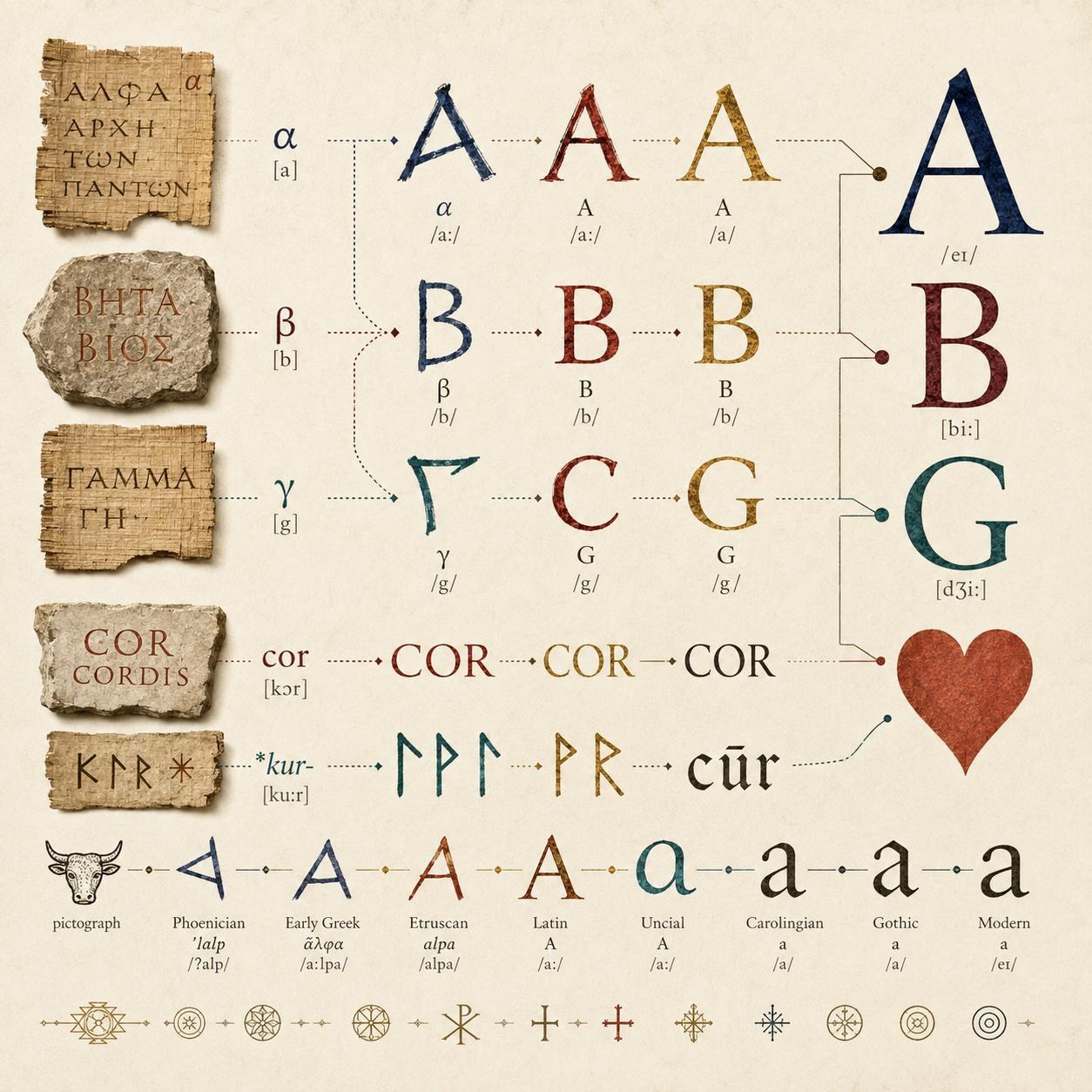
Spiritual psychology and etymology both point somewhere different. When you go back to the root of the words we use most, you find that language and reality have never been separate at all, and that every tradition that understood consciousness deeply already knew this. What "conscious" actually means? The word comes from the Latin conscius, and when you pull it apart, something interesting opens up. Con means "with" or "together." Scire means "to know," and it's also the root of "science," which means consciousness and science share the same origin. Both are fundamentally about knowing, about being in relationship with what is.
The specific Latin meaning of conscius is "knowing with." To be conscious means to know together with yourself, to hold awareness alongside your own experience as it unfolds, to witness from within.
This matters in spiritual psychology because it tells you what kind of being you actually are. You're a consciousness that knows with itself. You're an individualised expression of the field, wearing a body, running patterns, carrying a specific emotional history, and you have the capacity to step back and see what's running beneath the surface. That capacity is where creation begins, because a being who cannot know with itself will only recreate what's already been encoded. The unconscious creator does exactly that. The conscious creator observes the programming and makes a different choice. What "creation" actually means From the Latin creare: to make, to produce, to grow. The word is related to crescere, to grow, to come into being. And when you understand that root meaning, the whole act of creation looks different.
Creation, in this root sense, is growing something from what already exists in potential. You're participating in what grows from the field of consciousness, shaping what comes into form through where you place your awareness, your emotional state, your declarations. The universe grows what you're actually feeding, not what you're wishing for, but what you're consistently directing attention and emotional energy toward. The ancient understanding most people have forgotten Hebrew has a word that holds this entire framework in a single syllable: dabar (דָּבָר).
Dabar means "word." And it also means "thing" and "event," because in ancient Hebrew thought those were never separate concepts. The naming of a thing and the thing itself were understood as the same act. What is spoken comes into being. What you name, you make real.
You see this across traditions. In the Gospel of John: "In the beginning was the Word, and the Word was with God, and the Word was God." Genesis has God creating entirely through speech. "Let there be light." The word precedes the form every single time.
Every ancient tradition that took consciousness seriously understood that language and reality are participatory. Language was never a label placed on something that already existed independently. It was understood as part of the process by which things came into existence at all.
Modern people inherited a different story: that words are symbols, neutral tools, arbitrary sounds attached to preexisting objects. That framework produces a very specific relationship with speech. You say "I always struggle with money" and hear it as an honest observation. You say "I'm not someone who gets to have that" and hear it as a description of the facts.
Spiritual psychology names what those actually are: declarations. Commands being fed into the subconscious, which then grows exactly what you've been saying, year after year, until the declaration and the life it created look like the same thing. What modern research confirms Ethan Kross, professor of psychology at the University of Michigan and director of the Emotion and Self Control Lab, has spent years researching what he calls the inner voice. His finding is that the verbal stream plays an indispensable role in the creation of the self, that the brain constructs meaningful narratives through autobiographical reasoning, using language to write the story of your life with you as the main character.
You are authoring yourself with your words. And that authorship, according to Kross's research, directly shapes how the brain processes identity, emotion, and what actions feel available to you.
Research in linguistic relativity, rooted in the work of Edward Sapir and Benjamin Lee Whorf and supported by decades of experimental studies, has documented the same principle from a different angle: the language you use shapes what you can actually perceive and experience. Languages with specific words for emotional states produce speakers who can recognize and regulate those states more effectively, because the word creates the category, and the category makes the experience visible. The structure of language shapes the structure of what's real to you. The subconscious declaration problem The subconscious commands we've covered in this series, "I am not enough," "love requires sacrifice," "suffering is what keeps me safe," are verbal structures that have been spoken, heard, repeated, and encoded as identity.
They came from somewhere. A parent's words. A repeated experience. A conclusion the nervous system drew and then put into language to make it stick. And now they run like code, narrating reality into a specific shape, below the level of conscious choice, so automatic that most people genuinely believe they're just describing the truth.
Conscious creation, in spiritual psychology, is the deliberate use of language from a cleared emotional state to grow something different. And the word "deliberate" matters here, because affirmations spoken on top of an active emotional charge are still unconscious in a specific way: the verbal layer says one thing while the subconscious layer runs the old declaration underneath, and the subconscious always has more hours in the day.
The sequence from the previous posts in this series: identify the charge, process it through the body, reach emotional neutrality, and from that cleared state, speak the new declaration. Now the word and the inner state are in agreement. Now you're creating consciously, the way the word was always meant.
Unconscious declaration → Conscious declaration
Said automatically, without awareness → Chosen deliberately from a cleared state Describes the past as fixed reality → Grows a new reality from present awareness Spoken from emotional charge → Spoken from emotional neutrality Reinforces the subconscious blueprint → Begins rewriting it "I always end up alone" → "Connection is available to me" "Money is always a struggle" → "Abundance is my natural state" Creating unconsciously → Creating as a conscious being What this means for how you speak? Every sentence you say about yourself is participatory. Every time you describe your limitations as fixed, you're speaking them further into form, feeding the subconscious the command to keep growing exactly that. Every time you name what you're choosing with clarity and conviction from a settled emotional state, you're speaking that into form instead, and the difference between those two acts is the difference between unconscious and conscious creation.
This is what spiritual psychology means when it talks about conscious creation. You're a being made of consciousness, with the capacity to know with yourself, and therefore the capacity to choose what you grow with your awareness, your emotion, and your declarations.
Dabar: the word and the thing are the same.
If the declarations you've been making about yourself no longer reflect who you're choosing to be, that's the work. Book a conversation at sovselfpath.com and find out what you've been speaking into your life.
FAQ Is this the same as affirmations?
Affirmations are declarations made at the conscious level, often on top of an active subconscious charge running in the opposite direction. The ancient understanding of dabar and the spiritual psychology framework both require congruence: the word and the inner state need to be in agreement. A declaration made from emotional neutrality, with the subconscious blueprint cleared or being actively cleared, has a completely different effect than an affirmation spoken over fear or scarcity.
Why does my language about myself feel so automatic?
Because most of it was written before you had the awareness to choose it. The inner narrator Kross describes was shaped by what you heard repeatedly, what was spoken over you, and what conclusions your nervous system drew and then encoded in language. The declarations became automatic because the subconscious encoded them as identity. Making the automatic visible is the first step. Choosing different words from a different emotional state comes after.
How does spiritual psychology approach language differently from mindset work?
Mindset work typically operates at the level of thought replacement: identify a negative thought, replace it with a positive one. Spiritual psychology goes deeper. The word comes from the level of consciousness itself. The work is to become the being who speaks from a cleared and sovereign state, not to add better content on top of an unchanged identity. The language changes because the identity changes. In that order.
Can I change my reality just by changing my words?
The word is one part of the triad. Emotional state and repeated embodied action are the other two. Dabar in the ancient sense wasn't a casual utterance. It was a speech carrying the full weight of the speaker's being. Conscious creation requires that same congruence: cleared emotional state, deliberate declaration, and the behavioral repetition that makes the new identity more familiar than the old one.
Ready to choose what you speak into existence? The declarations running your life right now were written by a self that was doing the best it could. They can be rewritten by the self you're consciously becoming.
The 12-week Sovereign Self Path container is where that work happens, from identifying the old declarations to building the new identity through embodied repetition.
Book a conversation at sovselfpath.com.